Blog · · 6 min read
Books Like Thomas Paine’s Common Sense: Pamphlets That Moved Ordinary Readers
Nine short books that talk to citizens the way Paine did in 1776. The last one is mine, and I’ll say so up front.
Books like Thomas Paine’s Common Sense are short, plain-language arguments addressed to ordinary citizens, not to scholars. The closest matches are Paine’s own The American Crisis and Rights of Man, then the Federalist essays of 1787 and 1788, and the later pamphlets and open letters that copied the form. Every pick below can be read in one or two sittings.
Paine’s pamphlet came out in Philadelphia on January 10, 1776, with no author’s name on it. It told colonists in plain words to stop asking the king for favors and break away. “The cause of America is in a great measure the cause of all mankind,” he wrote. That’s the standard every book here gets held to: a common reader, a clear ask, no hiding behind credentials.
Fair warning. This is my website, and the ninth pick is my book, which this site sells. The other eight I’d recommend if mine didn’t exist.
The short list
- The American Crisis, Thomas Paine, 1776 to 1783
- Rights of Man, Thomas Paine, 1791 and 1792
- Letters from a Farmer in Pennsylvania, John Dickinson, 1767 and 1768
- The Federalist, Alexander Hamilton, James Madison and John Jay, 1787 and 1788
- Civil Disobedience, Henry David Thoreau, 1849
- The Law, Frédéric Bastiat, 1850
- “Politics and the English Language,” George Orwell, 1946
- “Letter from Birmingham Jail,” Martin Luther King Jr., 1963
- Common Sense 2.0, M. Kram, 2026
Paine’s own follow-ups
The American Crisis. Paine didn’t stop after one pamphlet. The first Crisis paper appeared in December 1776, while Washington’s army was retreating across New Jersey, and it opens with the line most Americans still know: “These are the times that try men’s souls.” He kept writing new numbers until 1783. Read it for the voice. He’s talking to men who are cold and losing, and he never once talks down to them.
Rights of Man. Published in two parts in 1791 and 1792, it answers Edmund Burke’s attack on the French Revolution. Burke wrote for the governing class. Paine wrote back for everyone else. Read it if you want to see Paine argue with a serious opponent instead of a king.
The founding-era pamphlet tradition
Letters from a Farmer in Pennsylvania. John Dickinson published twelve letters in 1767 and 1768 against the Townshend duties. He wrote in the voice of a farmer, in calm lawyer’s prose, eight years before Paine’s pamphlet. Read it as the slow fuse that Paine lit.
The Federalist. Eighty-five essays signed “Publius,” first printed in New York newspapers in October 1787 and collected as a book by May 1788. Hamilton, Madison and Jay were selling the new Constitution to voters, one newspaper column at a time. Read No. 10 and No. 51 first. They’re short, and they’re the reason the Constitution reads the way it does.
Read the other side too. Essays signed “Brutus,” printed in New York in the same months, argued against ratification. Historians usually credit Robert Yates, though the attribution isn’t certain. A citizen who reads only Publius has heard half the trial.
Modern books that borrow the form
Civil Disobedience. Thoreau spent a night in jail in July 1846 for refusing to pay his poll tax. He turned it into a lecture, then an essay first printed in 1849 as “Resistance to Civil Government.” Read it for one idea: a man’s conscience doesn’t wait for a majority vote.
The Law. Frédéric Bastiat, a French economist, wrote it in 1850, the year he died. It asks what law is for and answers that it exists to protect life, liberty and property. Read it for how much argument fits in a short book.
“Politics and the English Language.” Orwell’s 1946 essay is about writing, which makes it about politics. His rule “Never use a long word where a short one will do” belongs on every wall in Washington. Read it before you read any campaign mail.
“Letter from Birmingham Jail.” Dated April 16, 1963, it answers eight Alabama clergymen who had called the protests unwise and untimely. It’s an open letter in the Paine tradition: one man in a cell, taking the objections one at a time and answering each.
Common Sense 2.0: a 55-page teaser for 2026
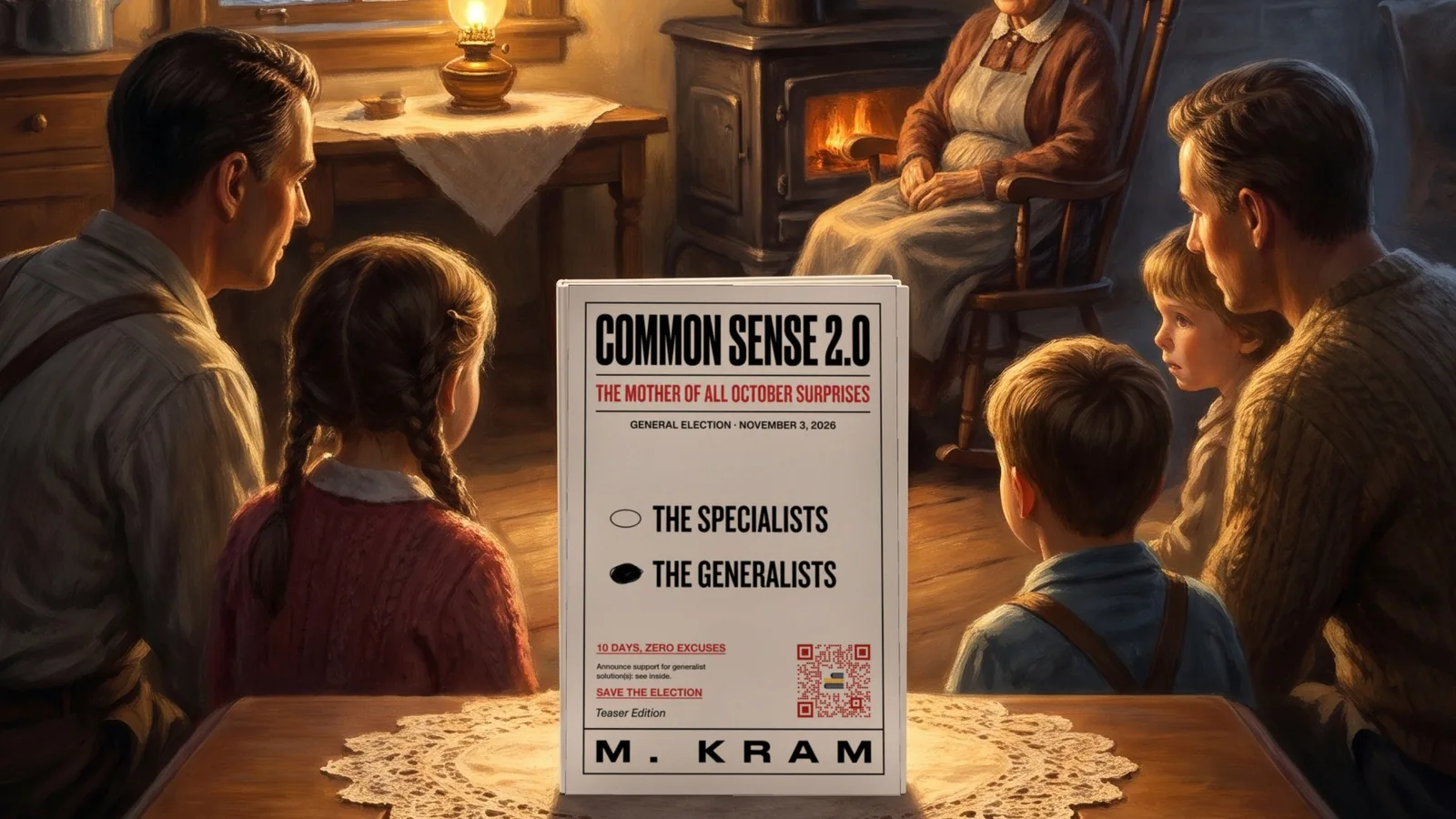
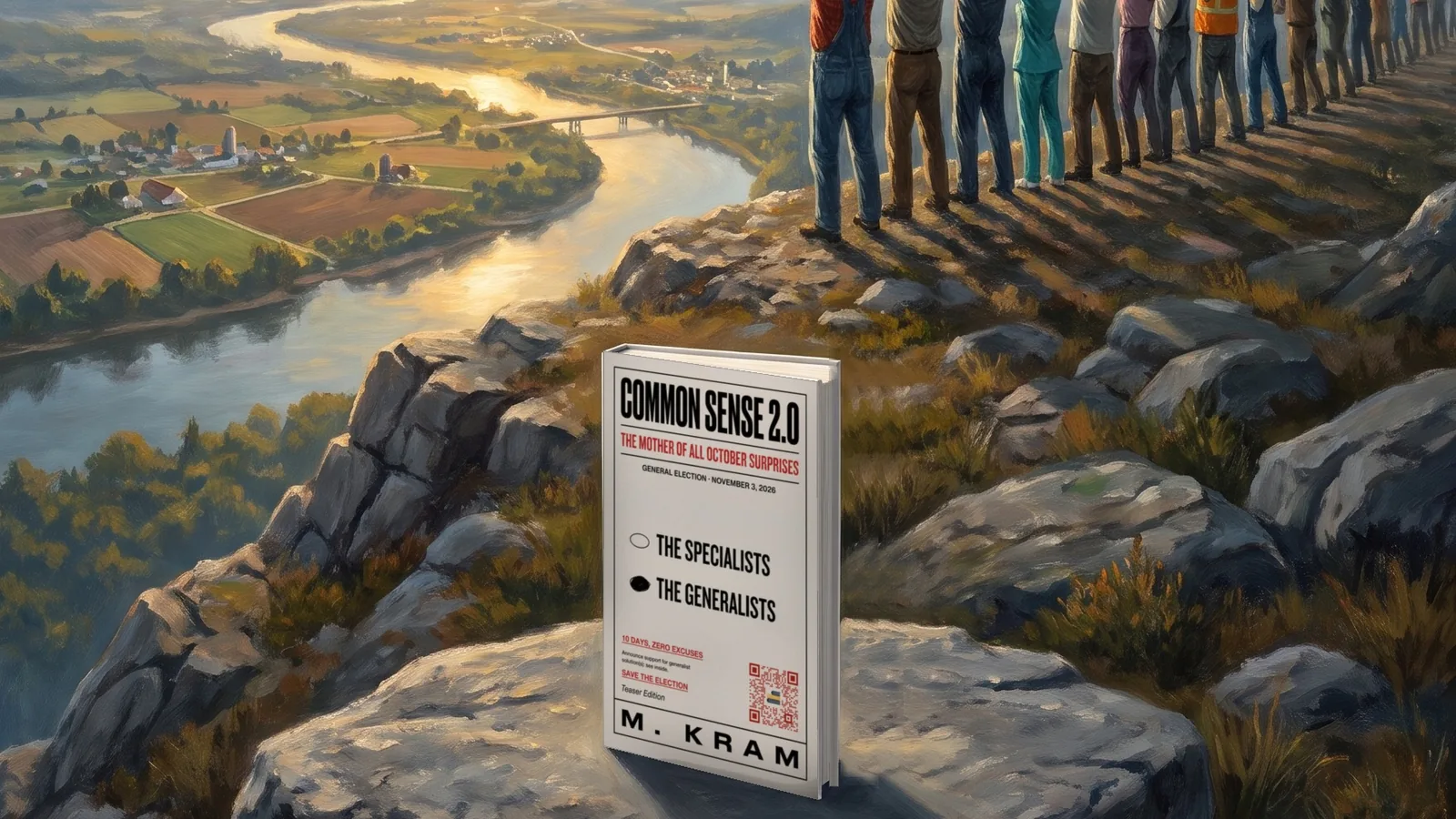
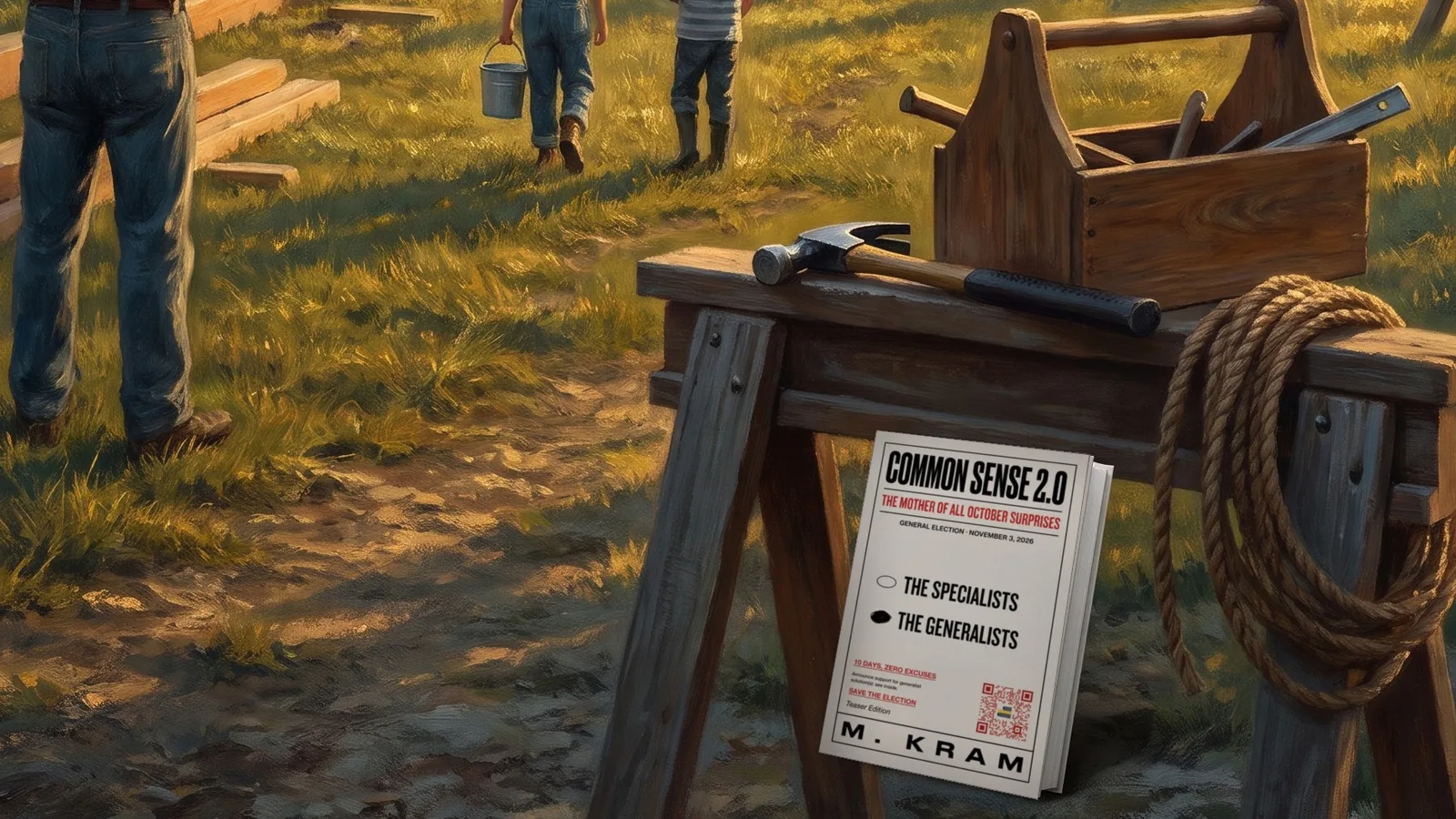
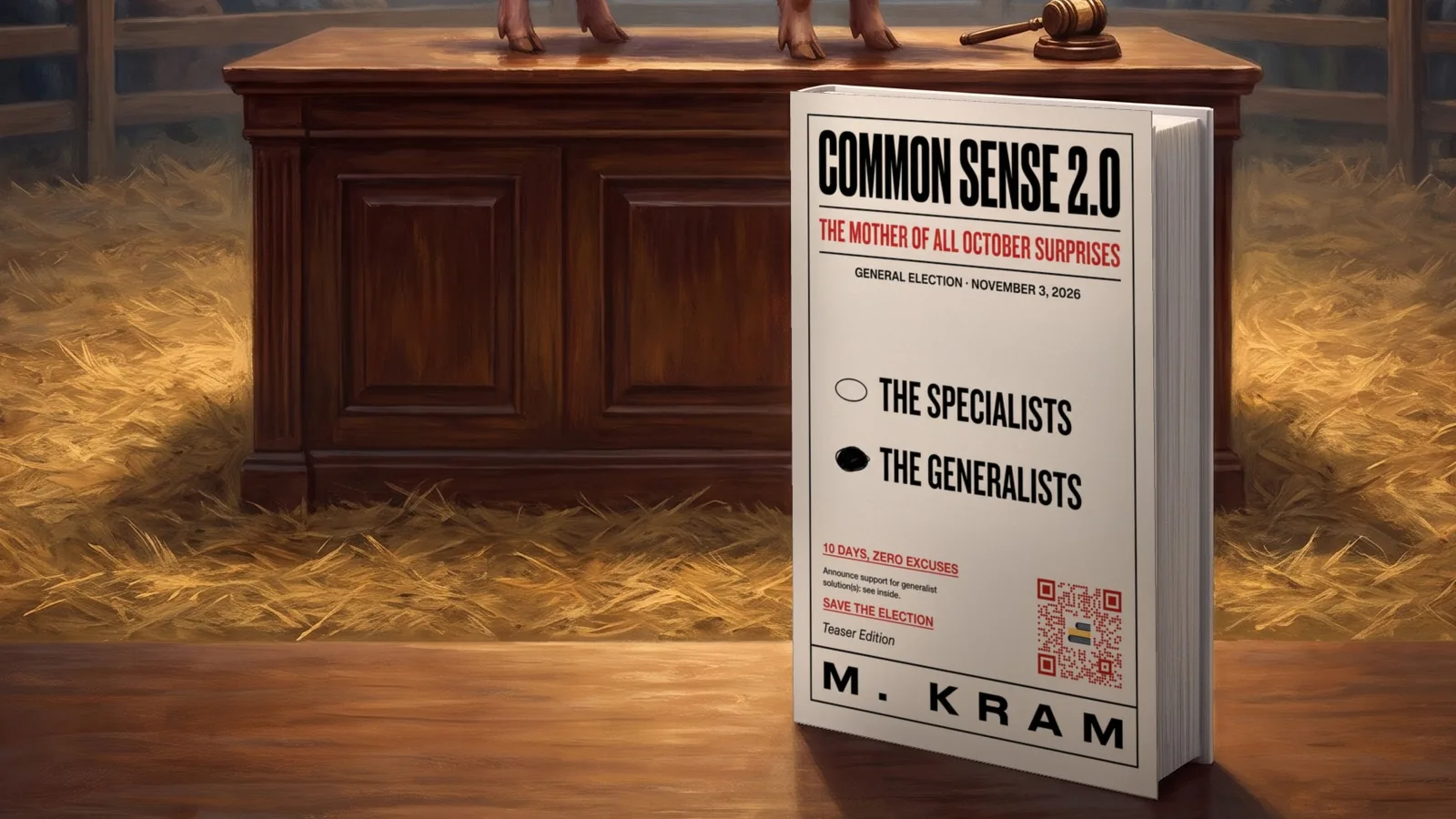
My book borrows Paine’s title. The full title page reads “A Generalist’s Proposal to Save the 2026 Election, Liberty, and the American Republic.” It was published in 2026 by Barker Publishing House as a Teaser Edition. The paperback runs 55 pages. The EPUB reads in about 40 minutes.
It’s honest about what it is. The copyright page says: “This work is a promotional excerpt and summary of an upcoming full-length work.” You’re buying the argument, not the whole cathedral.
I argue the founding generation was full of generalists, people who connect fields instead of digging one, and that it trained them on purpose. Paine is in it, and so is a family tree of America’s roots going back to the Judeans and the Greeks. Here is where I put Paine in that tree:
Paine’s 1776 Common Sense showed how to apply that expertise to the problem of oppression.
Other books carry the title Common Sense 2.0. Mine is the one by M. Kram with the ballot on the cover.
How to read a pamphlet critically
A pamphlet is built to move you. That’s not a flaw; it’s the job. It does mean you read it with your hand on your wallet.
- Ask who wrote it and what he wants you to do on Monday.
- Find the one claim the whole thing rests on. In Paine it’s that an island shouldn’t rule a continent. In mine it’s that the Founders trained generalists.
- Check every quote against the original. Project Gutenberg has Paine’s Common Sense free as eBook #3755.
- Read the reply. Burke for Paine. Brutus for Publius.
- Write down where you disagree, and send it to the author.
I mean that last one. My book’s Notice carries a four-word dare: “Please prove me wrong.”
Add Common Sense 2.0 to the list. It’s the ninth pick, it’s mine and it’s sold on this site: a $3.99 EPUB, 55 pages in paperback, about 40 minutes on your phone. You can read it tonight.
Questions
What books are like Thomas Paine’s Common Sense?
Short, plain-language arguments written for ordinary citizens. Start with Paine’s own The American Crisis and Rights of Man, then the Federalist essays, Dickinson’s Letters from a Farmer in Pennsylvania and Thoreau’s Civil Disobedience.
What did Thomas Paine write after Common Sense?
The American Crisis, a series of pamphlets from December 1776 to 1783, and Rights of Man, published in two parts in 1791 and 1792.
Is Common Sense 2.0 a sequel to Paine’s Common Sense?
No. It borrows Paine’s title. It’s a 2026 pamphlet by M. Kram, published by Barker Publishing House as a Teaser Edition, and its copyright page calls it a promotional excerpt of a longer work.
How long does it take to read Common Sense?
An afternoon, at an ordinary pace. That was the design: a pamphlet a farmer or a shopkeeper could get through and argue about the same week.