Blog · · 7 min read
The Tree of Knowledge: A Pencil-and-Paper Game for Thinking in Steps
One pencil, two nouns, a short list of verbs. The game from Appendix 4 of my book, with the rules exactly as I wrote them.
The Tree of Knowledge is a one-player paper game. You pick two nouns, then get from the first to the second by changing one thing at a time with paired “reversible verbs” such as specialize-generalize. Each change is a step. Fewer steps is a better score. I wrote it into Appendix 4 of Common Sense 2.0 to train generalist thinking, and you can play it tonight.
The game in one paragraph
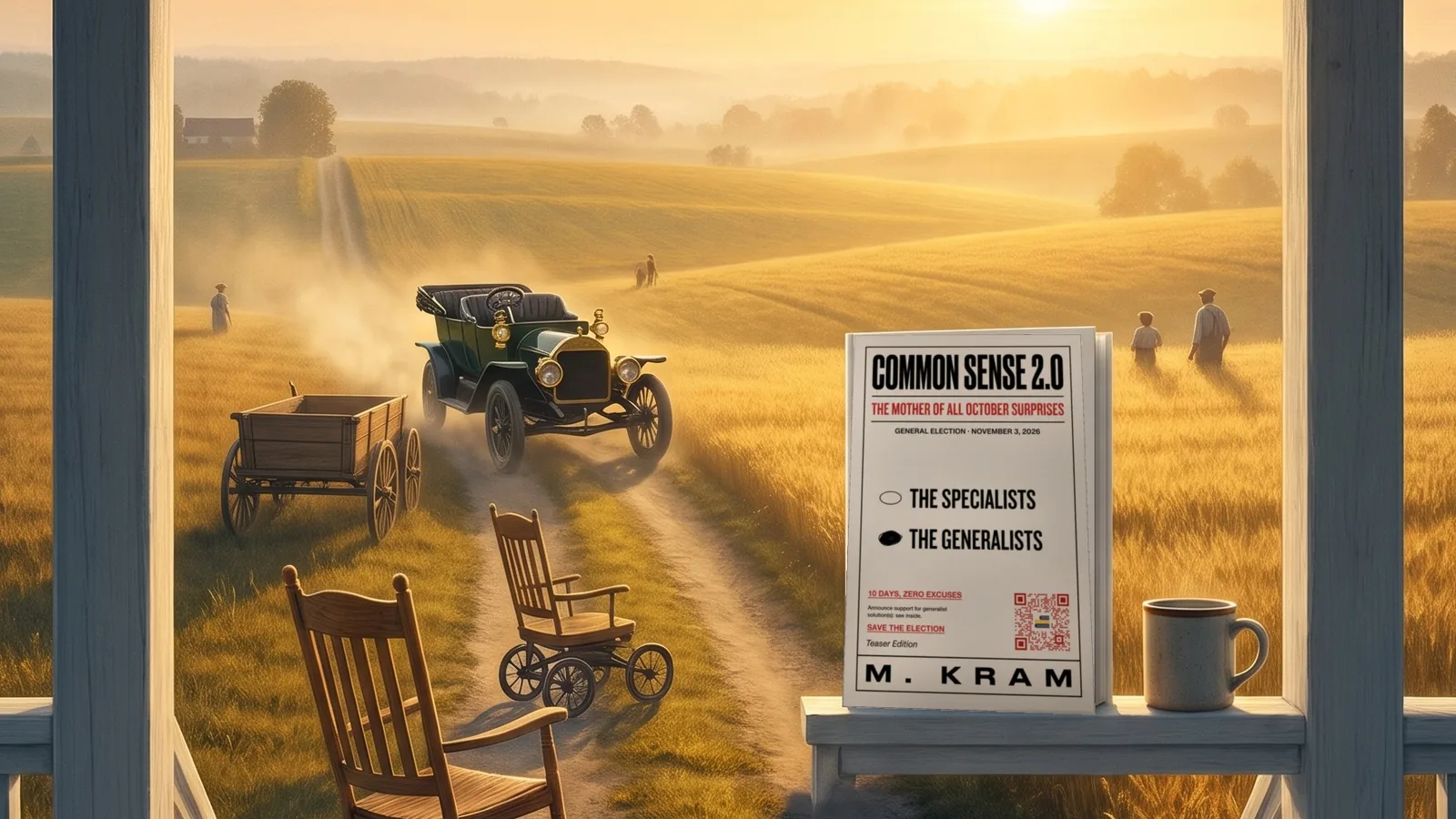
You draw a tree. Every noun you can name lives on its own leaf. You walk from a starting leaf to an ending leaf, and each move may change only one aspect of the thing you’re holding, using only a verb that can run both ways. Count the moves. A rocking chair can become an early motor car in four moves, and the rest of this post shows you how. Then you can try it on a teacup and a battleship.
What you need: paper, pencil, a list of reversible verbs
Paper and a pencil. That’s all the equipment.
The one thing you build before you play is a short toolbox of reversible verbs. A reversible verb is a pair that works in both directions. The book gives the starter pairs: “add-subtract or specialize-generalize,” and the worked example adds “interpolate-extrapolate.” You can add your own as you go. Heat-cool. Join-split. Shrink-enlarge. The test is simple: if you can run the verb backward and land where you started, it goes in the toolbox.
Keep the list short at first. Three or four pairs will carry you a long way.
Rules, step by step
Here are the rules as the book prints them. The opening line is “Sketch a basic two-dimensional tree with a few leaves.”
Rule a reads: “Prove to your satisfaction that every noun in any vocabulary or dictionary can find a unique home on a separate leaf of such a tree. Also draw up a list of reversible verbs, like add-subtract or specialize-generalize, to build your toolbox.”
Rule b is the game itself:
Prove to your satisfaction that you can “get” from any starting leaf to any ending leaf by single-stepping: changing one aspect of the starting leaf with one of the reversible verbs, then one aspect of each intermediate leaf in turn, until you arrive at the ending leaf. Rank the accomplishment by the fewest steps.
In plain terms: one change per step, one verb per change, and every in-between noun has to be a real thing you could point at. No leaping. If a step changes two things at once, split it into two steps and count both.
Worked example: rocking chair to 1910 Hupmobile in 4 steps
This is the example from the book, word for word. Starting leaf: “rocking chair.” Ending leaf: “1910 Mod. 20 Hupmobile motor car.” Reversible verbs: “specialize-generalize, interpolate-extrapolate.”
- “Extrapolate rocking chair to rolling chair”
- “Extrapolate rolling chair to rolling vehicle”
- “Specialize rolling vehicle to motor car”
- “Specialize motor car to 1910 Mod. 20 Hupmobile motor car”
“Rating: 4 steps.”
Look at what each step does. Step 1 keeps the seat and swaps rocking for rolling. Step 2 keeps the rolling and stretches the seat into a vehicle. Step 3 narrows the vehicle down to one kind, the kind with a motor. Step 4 narrows the motor car to one make, model and year. Four single changes, each one checkable.
Could you do it in three? Try. That’s the game.
There’s a second level, and it’s where the thinking pays off. You ask which properties of the first noun survive the whole walk. The book’s answer for the rocker: it “likely protects the rider’s fingers from the floor and from being mashed between rockers and floor. No step’s reversible verb touches that protection, so we anticipate that it will survive all the way to car B.” In other words, the chair already told you the car should keep its passengers’ hands and bodies safe.
Then the line I’d underline twice: “the generalist does not care whether the protections, or the basic relationships, actually carry through, or can be made to carry through.” His job, the book says, is to save “time, money, material, lives, projects, programs, and reputations by raising options, alternatives, anticipations, and considerations that no one else sees or can find.” The game trains you to raise the option. Somebody else can test it.
Two more games from the book: Three-Part System and Second Noun
Appendix 4 has three games. The other two stretch the same muscle.
Game 2, A Three-Part System. The setup: “Draw an equilateral triangle with a word bubble replacing each intersection, and a title box centered underneath.” Nouns go in the bubbles, verbs on the lines between them. You single-step from one whole system to another by changing one word at a time. The book’s example starts with “A green chair consists of a rounded seat securely attached to a 16-inch leg assembly and a slightly splayed back” and ends with “A rusty 1936 Hupmobile with a giant oak growing up through the rumble seat.” Two steps: “Generalize chair to human ensconcement,” then specialize “human ensconcement” to the ending system.
Game 3, Second Noun. This one takes two players, who alternate to “select the medium from which the first noun will be chosen, such as the page of a dictionary, magazine, or newspaper,” then “put a finger down on the medium without looking closely,” then “select the closest interesting noun, radiating out from the fingertip,” then “switch players and repeat the process to select the second noun.” The rule for winning: “The winner finds the fewest steps to ‘get’ from the first noun to the second.” At the prediction level, “the winner produces the most substantial body of predictions about the second noun, based only on what he can carry over from the first.”
The book’s example: first noun “manila folder,” second noun “Nautilus (govt’s first nuclear sub).”
Player a makes one step, “specialize ‘manila folder’ to be govt. property (same as Nautilus),” and predicts the sub runs through the same government property life cycle: “specification; Request for Quotation; Purchase Order; inspection; useful life; disposal.” Score: “1 step + 6 predictions.”
Player b also takes one step, but a smarter one: “specialize both ‘manila folder’ and ‘Nautilus’ to be an ‘envelope’.” Now the predictions pour out, starting with “an envelope can easily be identified and re-identified by changing its label” and “an envelope can easily and secretly hide anything that fits inside.” The book leaves the list open with “etc., etc.” Score: “1 step + many predictions: The winner!!”
Same number of steps. Player b won because he picked the step that opened the most doors. That is the right question, found by playing.
Printable score sheet
Copy this onto an index card or the inside cover of a notebook. One row per round.
| Start noun | End noun | Verbs used | Steps | What carried through |
|---|---|---|---|---|
| rocking chair | 1910 Mod. 20 Hupmobile motor car | extrapolate, specialize | 4 | rider kept clear of harm |
Play the same pair again a week later and see if your step count drops. Write the new verbs you invented in the margin. Those are the start of your toolbox.
All three games live in Appendix 4 of the book, along with why I think this kind of training built a country. The full set is in the $3.99 EPUB, about 40 minutes of reading, and the file is yours to keep. Play a round first. If the rocking chair gets you thinking, the rest of the appendix will too.
Questions
What is the Tree of Knowledge game?
A one-player paper game from Common Sense 2.0. You get from one noun to another by changing one aspect at a time with reversible verbs, and fewer steps is a better score.
What are reversible verbs?
Verbs that come in pairs and can run either way, like add-subtract, specialize-generalize or interpolate-extrapolate. They are the only moves allowed in the game.
How do you score the Tree of Knowledge?
At the first level you count steps, and fewer wins. At the second level you count the properties of the first noun that survive every step and carry through to the last one.
Is the Tree of Knowledge the same as a word ladder?
No. A word ladder changes one letter at a time. The Tree of Knowledge changes one aspect of meaning at a time, so the chain has to make sense, not just spell.