Blog · · 6 min read
Generalist vs Specialist: What’s the Difference and Which Do We Need?
A specialist digs one hole deep. A generalist knows which hole to dig. I argue America was built by the second kind.
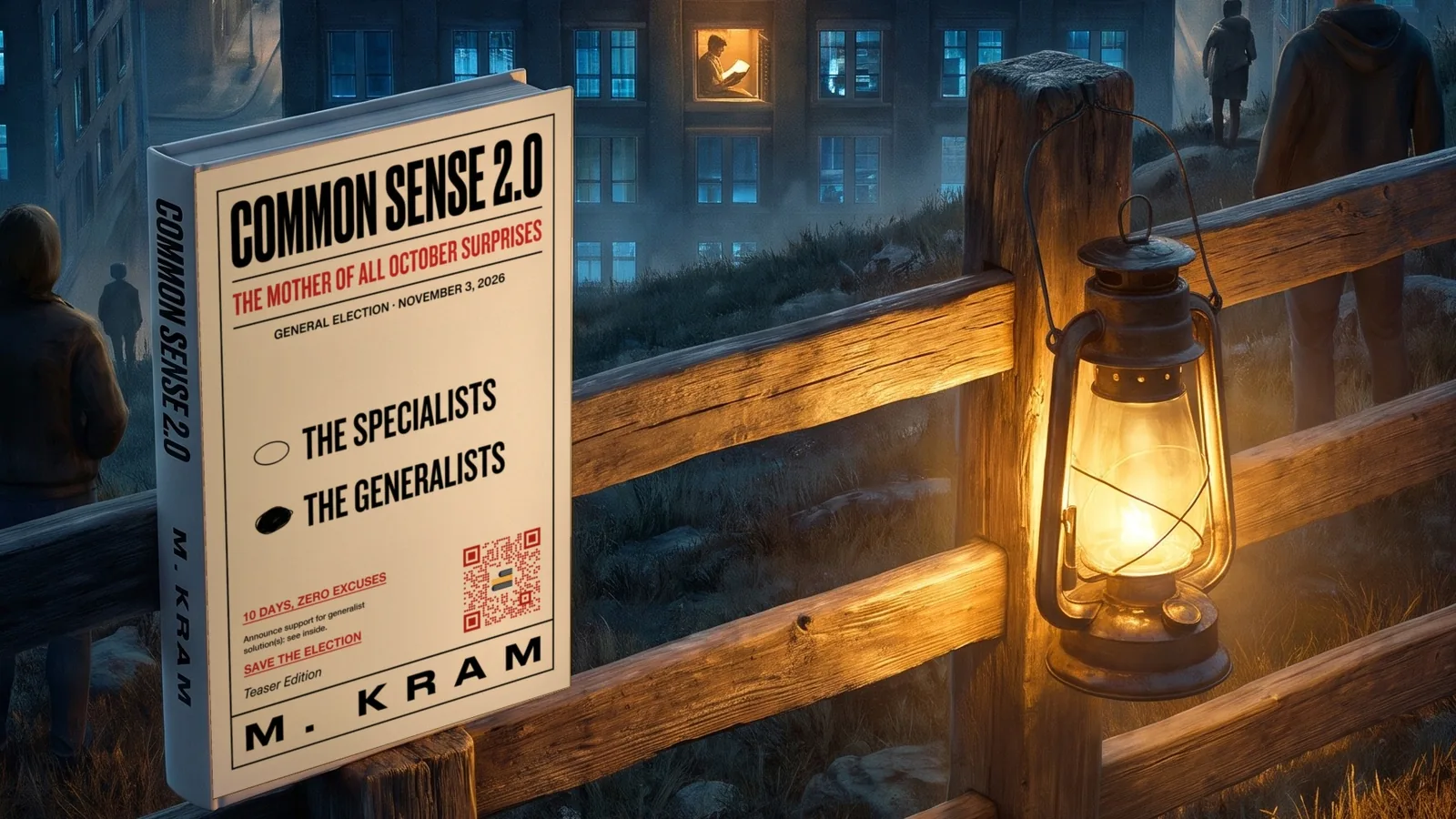
A specialist knows one field deeply. A generalist links many fields to solve problems no single field can. That’s the difference, and I mean people, not the biology sense where one animal eats a single plant and another eats whatever it finds. We need both kinds. My argument in Common Sense 2.0 is that we have plenty of specialists and almost no generalists left.
That last part is where people start arguing with me. Good. Read the rest first.
Generalist vs specialist: two definitions (and not the biology one)
Search “generalist vs specialist” and half the results are about species. Biologists use the words for animals that live on a narrow diet or a wide one. Useful for a zoology test. Useless for deciding who should run a county, a company or a country.
For people, the specialist is easy to define. He picks one subject and digs. Every year he goes deeper, and every year he knows more about less. Medicine, law and engineering are built on him, and they should be.
The generalist is harder to pin down, so I wrote my own definition into the book:
A multispecialist with unusual skill analyzing material relationships, a record of anticipating practical solutions to ‘intractable’ problems, inventing whatever is necessary, and an unrelenting drive to solve the biggest problems of his world.
Notice the first word. A generalist isn’t a dabbler who skimmed ten subjects. He’s gone deep more than once, and his real talent is seeing how one field’s tools fit another field’s problem. The specialist asks how a thing works. The generalist asks what it’s connected to.
What specialists do best
I’ll give the specialist his due, because the book does too. Here’s how I put the old view: “Traditionally, specialization was the gold standard: the deeper a man could dig into a subject, the more valuable he became.”
That view earned its place. If a valve in your heart fails, you don’t want a man who knows a little about hearts and a little about plumbing. You want the surgeon who has replaced that valve so many times he could do it half asleep. Same with the electrician who wires your panel, or the machinist who can hold a part to a tolerance you can’t see.
Specialists are at their best when the problem is already named, the field is already mapped, and the job is to do the known thing better than anyone else.
Trouble starts when the problem has no name yet.
What generalists do best
A generalist is at his best when a problem sits across three or four fields and every specialist in the room says it belongs to somebody else. Think of a town where the water bill jumped, the plant is old, the engineer blames the budget, the budget office blames the state, and the state blames the engineer. Nobody is lying. Nobody is looking at the whole thing either.
The generalist’s job, as I describe it in Appendix 4, is to raise “options, alternatives, anticipations, and considerations that no one else sees or can find.” I also make a promise for the skill there: “in most predicaments those options include a cheap, simple exit.”
Cheap and simple. Those two words annoy specialists more than anything else I say.
The old view put the generalist in second place. In the book’s words, “a generalist would do until a strong enough specialist came along.” I think that has it backwards. A specialist does the job. A generalist figures out which job is worth doing.
Examples from history and everyday work
Ben Franklin is the name everyone reaches for, and for good reason. Printer, writer, inventor, postmaster, diplomat. He didn’t hold those jobs one after another like a man changing careers. He carried what he learned in one into the next. Jefferson wrote the Declaration and designed his own house at Monticello. In the book I joke that you used to have to wait “for the right astral alignment, or whatever else delivered the next da Vinci or Franklin.”
You don’t need a powdered wig to see the pattern, though. Look around a small town.
The general contractor doesn’t pour every footing or pull every wire, but he knows enough about the plumber’s job to catch the plumber’s mistake before the drywall goes up. The family doctor sends you to the cardiologist, and the good one knows which cardiologist and why. A farmer is a mechanic in March, a vet in April, an accountant in December and a weather forecaster every morning of the year.
Each of those people is a generalist with at least one deep specialty. That’s my definition walking around in work boots.
Why the debate keeps coming back (Range, hiring, AI)
Every few years the argument comes back with a new coat of paint. David Epstein’s book Range is the title most people search for on this subject, and I’ll let its author speak for what’s in it.
Hiring keeps the debate alive too. Job ads ask for years in one software package, one industry and one title. Then the same company wonders why nobody inside can see the problem that’s sinking it.
And now there’s AI, and the question of whether machines make generalists obsolete. I argue they do the opposite. My line in Appendix 4: “Even dumb AI can add 2 and 2, if you can reduce a problem to that level of complexity.” The machine is a tireless specialist. Somebody still has to reduce the problem, and that somebody is the generalist. As I put it in the same appendix, “The edge, the genius, lies in asking the right question.”
One author’s case: the Founders were generalists
Here’s my case, and I’ll mark it plainly as my argument, not settled history.
I argue that the difference between 1776 and 2026 comes down to one thing. The Founders were full of generalists. Today we have almost none. By my estimate, generalists occur naturally at “roughly one per million births.” I argue the Founders didn’t beat those odds by luck: “they trained them.”
That is the whole thesis of Common Sense 2.0. A country of specialists can run a known system well. It can’t design a new one or fix an old one when the fault crosses every department. The Founders designed a republic that has carried us for 250 years. I don’t believe a room full of specialists could have done it, and I don’t believe one can repair it.
You can disagree. The Notice in my book carries a four-word dare for exactly that: “Please prove me wrong.”
In the book I call myself “this fly-over patriot generalist.” The full argument is about 40 pages, a 40-minute read, and it’s $3.99 as an EPUB you own outright, with the training games in Appendix 4. Read it, then tell me where I’m wrong.
Questions
What is the difference between a generalist and a specialist?
A specialist knows one field deeply. A generalist links many fields to solve problems that no single field can solve alone.
Is it better to be a generalist or a specialist in your career?
Most careers pay the specialist first. The generalist earns his keep when a problem crosses fields and the specialists keep handing it to each other.
Can a person be both a generalist and a specialist?
Yes. My own definition of a generalist starts with the word multispecialist: a man who has gone deep more than once and can see how the pieces relate.
Can you learn to be a generalist?
I argue you can. In my book I put the natural rate at roughly one per million births, and I argue the Founders beat those odds by training generalists.